Failure has none
The ship was recently in the news with the first combat employment of AEGIS BMD – SM-3. The history of AEGIS BMD – SM-3 is as interesting and convoluted (maybe more) than the development of the ship.
Some of those without whom AEGIS BMD – SM-3 would not have been on station, and maybe not even the ship – BMD provides a fresh relevancy to the AEGIS fleet.
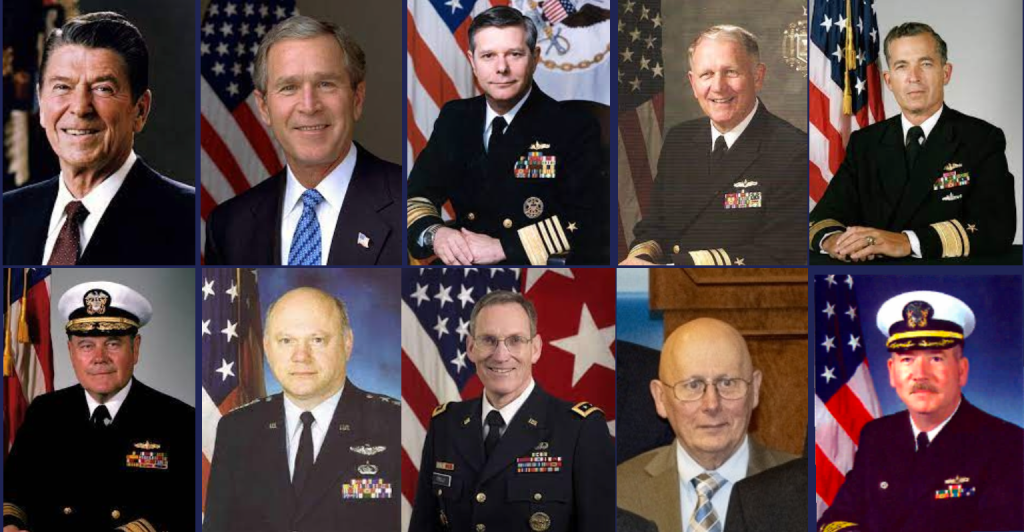
| Ronald Reagan | George W. Bush | ADM Boorda | VADM Rempt | VADM Williams |
| RADM Meyer | Lt Gen Kadish | LTG O’Reilly | Don Mitchell | RADM (Sel) Grant |
Ronald Reagan – The initial father of missile defense. He got the initial energy going on missile defense.
Wouldn’t it be better to save lives than avenge them? …
Ronald Reagan, Strategic Defense Initiative, March 23, 1983
George W. Bush – Cancelling the ABM treaty scared us all, but then we realized how much latent capability the system had once we looked under the hood. His mandate for the 9/30/04 initial capability deployment freed AEGIS BMD from the acquisition impediments, just as the capability was maturing. Strangely enough, as the 9/30/04 date approached, it became less politically acceptable to refer to the mandate. But the Destroyer was underway on 9/30/04, waiting for call for fire.
ADM Boorda – responded to the advocates listed below, and quickly pushed the Navy into Missile Defense. Directed BuPers to immediately dispatch 20* officers to the Ballistic Missile Defense Organization. Showed personal interest in Missile Defense progress, awarding officers, attending Blue Ribbon Panels, etc.
*In a related story, BuPers was working the “H”s that week, so the initial working party had a preponderance of H names.
VADM Rod Rempt – tireless advocate for Navy Missile Defense in the Pentagon and with Congress, drafted the original ORDs, which much to chagrin of missile defenders, did not require the multiple nines solutions. When OSD decided to prioritize THAAD and zeroed NTW budget, got the initial funds directly from Congress to start development. This support from Congress continued long enough for the program to become a success and become supported in the traditional budget process.
VADM J. D. Williams – another tireless advocate for Missile Defense. In many offices advocating for AEGIS BMD, especially in advanced roles that were not acceptable to mention at the time.
RADM Wayne E. Meyer – advocate for pushing AEGIS into Missile Defense, even as the Destroyer became the predominate platform, much to his dismay. Graded all our homework. Always looking for the next pearl, and fiercely guarding the Cruiser, fire control loop, and lexicon.
Lt Gen Ron Kadish – MDA director when Bush gave the execute orders. First coined the term “AEGIS BMD” and finally put his finger on the “dial a design” meter to stop the trade studies and start deployment. Accelerated the surveillance task in support of Ground Based Defense.
LTG Patrick O’Reilly – yes, really. When the SM-3 IB efforts stalled out for lack of contract, management, etc., reorganized the AEGIS Program for success, which gave the missile an advocate. Without him, the IB would have eventually died, while the IA became un-producable. Eventually became an advocate for the SM-3 BLK IIA efforts and got them back on track.
Don Mitchell – Guardian of test success in the early days. Refused to let the program pull the trigger until every unknown was characterized and mitigated. Forced ruthless test rigor that lasted for many years. Authored the Balanced Investment Strategy Study (along with CDR Jon Hill) that laid out the development track beyond the initial deployment capability. Tasked by LTG O to technically assess the stalled IB development program, identified path to complete development (most of which was never funded for other reasons, but gave a roadmap to success). Tackled some of the most difficult failure investigations.
RDML (Sel) P. M. Grant – longest tenured leader of Navy Theater Wide (initial program name). Started with almost no budget, staff, probability of success, and leadership support. Led the program through the early studies, funding uncertainty, “dial a design” period, and delivered the initial successful intercepts. The initial three back-to-back successful intercepts changed the perception and trajectory of the program.
This is only a small sampling of a pantheon of folks that made AEGIS BMD & SM-3 a success. More on the success of AEGIS BMD, including more names. Unfortunately, as with the history of the ship, naming all the heroes is an impossible task.
AEGIS BMD & SM-3 – Don’t leave home(port) without it.
 USS Arleigh Burke Association